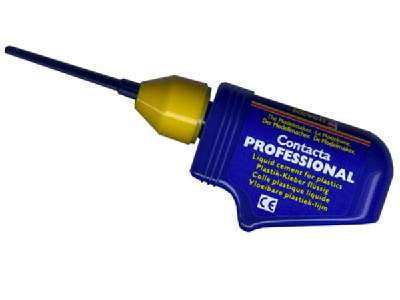
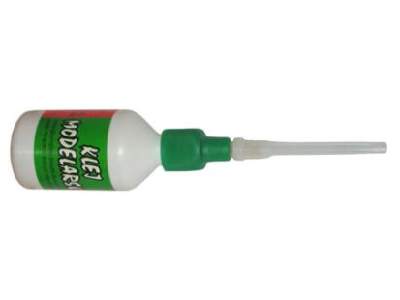


Paints and Glue are not included with any kit unless stated otherwise!
Versions:
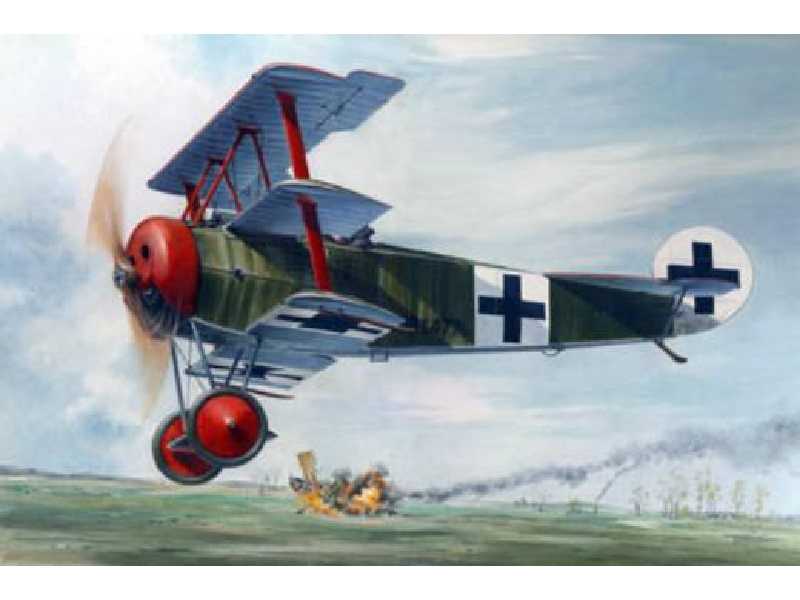
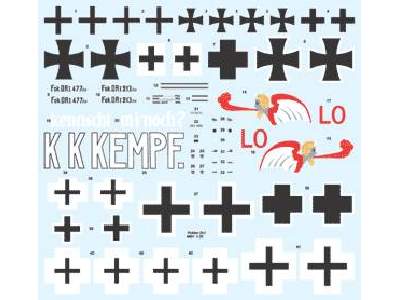
Fokker Dr.I, 213/17, Jasta 2 , Ltn.Friedrich Kempf, March
1918.
Fokker Dr.I, 477/17, JG1 , Rittm.Manfred von Richthofen, March
1918.
Fokker Dr.I, 450/17, Jasta 7, Ltn.Josef Carl Jacobs, Summer
1918.
Fokker Dr.I, 586/17, Jasta 4, Ltn.Ernst Udet, June 1918.
In the middle of 1917 the tide of battle in the
skies over the Western Front turned again, and not in Germany's
favor. Albatros and Pfalz fighters found themselves unable to put
up effective resistance against Allied planes of the latest design.
In particular, the new Sopwith Triplane impressed the Germans, a
plane that was winning many air battles for the British in the summer
of 1917. German aces gave the plane due respect and warned the High
Command it had the upper hand over their Albatross and Pfalz machines,
surpassing them entirely in maneuverability and climb rate.
One of the British Triplanes was brought down intact by the Germans,
and thoroughly examined. Air Force Inspection (Idflieg) soon placed
an order for a similar triplane. Among all the various designs proposed
by key manufacturers, Fokker's V4 project possessed the best specifications.
The aircraft would soon be known as the Fokker Dr.I, and it became
an iconic image of WWI.
In August 1917, two prototypes were placed at the disposal of Manfred
von Richthofen andEWerner Voss, serving with the elite unit JG1.
In October 1917, production examples were delivered to the front.
The Fokker Dr.I's compound structure consisted of a cable-braced
steel tube fuselage, and cantilever wings with wooden ribs and single
main box spar, all covered by fabric and plywood panels. All this
made the construction very light in weight. The machine was equipped
with a standard 110 h.p. Oberursel URII air-cooled engine, enabling
the aircraft to demonstrate excellent flying qualities. The Fokker
Dr.I was not especially fast, but its maneuverability, due to its
small dimensions, was considered unequaled at that time.
Because of defects in the upper wing, several Dr I crashed during
both combat and non-combat flights. It was not easy to fly the aircraft,
and inexperienced pilots were rather afraid to try; however, combat
experience proved that it could be a formidable weapon if flown
by an expert pilot, and it was sometimes flown in combat against
several enemy aircraft at once. Manfred von Richthofen, Ernst Udet,
Josef Carl Jacobs, Erich Loewenhandt and other famous German aces
proved that the Triplane had no equal in close-quarter combat. Even
after the well known 'best of the best', Fokker D.VII was added
to the German arsenal, notable aces continued to use it in special
cases. At the end of the war, though the fame of the Fokker D.VII
was at its peak, a few Fokker Dr.I were still serving.
320 Fokker Dr.I were produced, and of course it was a small number
to put up against the Allied Air Armada. Nevertheless, this distinctive
machine went down in history as one the most maneuverable aircraft
of the War, and as the famous mount of the Red Baron.
Performances
Wingspan
7,19 m
Length
5,77 m
Take-off weight
586 kg
Speed max
165 km/h
Engine
Oberursel URII, 110 h.p.
Armament
Machine guns 2oLMG 08/15 Spandau
This Photo-etched you can buy in company "TOM'S MODELWORKS" e-mail: tomsmodelworks@att.net.
Product Details
Roden 601
2008-03-08
Data sheet
Scale
1/32
Availability
Sold out
Shipping time
Unknown
Assortment / material
n/a
No carriers available for this product.
The above shipping costs are for 1 item only.
You will see the final shipping costs when you place your order.

@COMMENT_TITLE@
@COMMENT_COMMENT@