- Reduced price
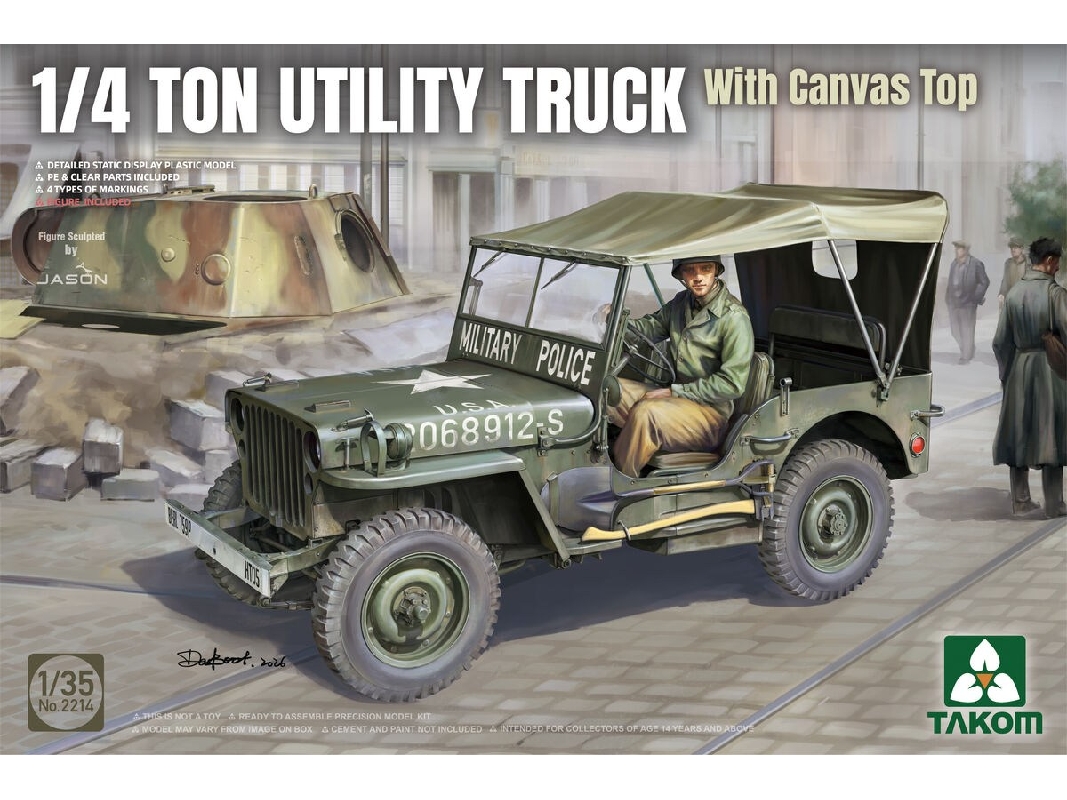
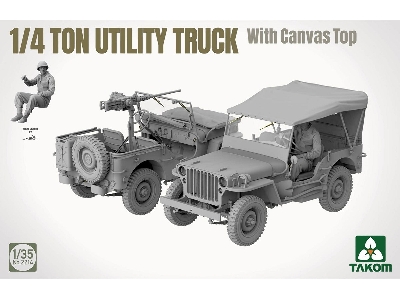
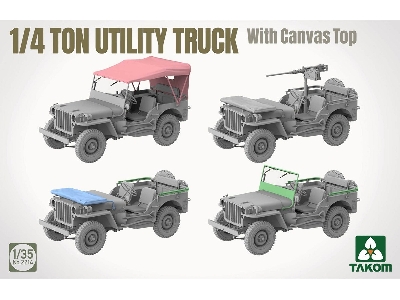
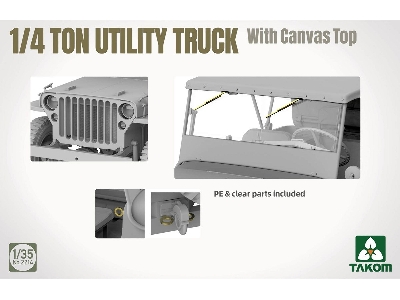
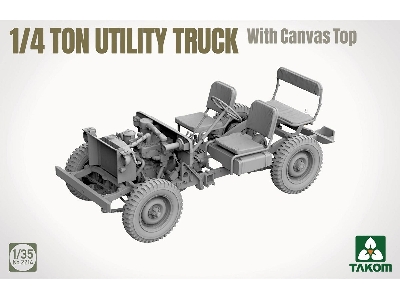
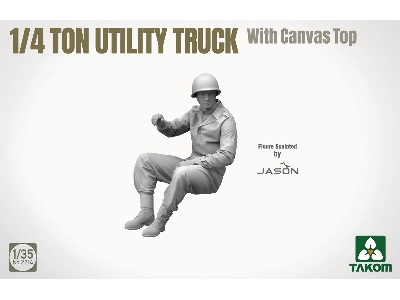
This model represents the American Willys MB, one of the most recognisable military vehicles of the Second World War. The kit allows the modeller to build the vehicle in a configuration with a canvas top, while the design also permits the vehicle to be displayed without the top. Its compact dimensions, simple silhouette and characteristic grille make it one of the vehicles most strongly associated with the mobility of American forces during the war.
Takom has paid close attention to the construction of the vehicle. The model features a detailed engine compartment, including the engine and associated components, as well as a detailed chassis, drivetrain and suspension. This makes it suitable not only as a finished vehicle but also as part of a more elaborate maintenance or field-service diorama.
The canvas top can be installed or omitted, while the windscreen can be positioned either raised or folded down. The kit also provides an optional M2 Browning heavy machine gun, allowing the modeller to create a more heavily armed field configuration.
The history of the Jeep began in 1940, when the U.S. Army was looking for a lightweight and versatile vehicle that could be produced in large numbers. The requirements included four-wheel drive, low weight, good mobility and the ability to carry personnel and equipment over difficult terrain.
Several manufacturers took part in the development programme. One of the first companies to produce a suitable vehicle was American Bantam, whose BRC prototype demonstrated the potential of a small, highly mobile military vehicle. The design work subsequently contributed to further development by Willys-Overland and Ford.
Willys developed its own version of the vehicle, powered by the Go Devil engine. This engine became one of the defining elements of the design, giving the relatively small vehicle good performance and considerable flexibility in off-road conditions. Series production began as the United States was preparing for large-scale involvement in the war.
The Willys MB eventually became one of the standard light vehicles of the U.S. armed forces. Because the demand was enormous, Ford also produced a closely related version designated GPW. Although there were some production and manufacturing differences, both vehicles performed essentially the same basic roles.
The Willys MB was used virtually everywhere American forces operated. It served as a reconnaissance vehicle, command and liaison vehicle, personnel carrier and transport for equipment, ammunition and supplies. Its compact size allowed it to operate on narrow roads and across terrain where larger vehicles had difficulty manoeuvring.
The Jeep could carry a driver and several passengers, while the rear compartment could be used for equipment and supplies. Depending on the configuration, it could also tow light trailers and support light artillery and other equipment.
One of the vehicle's greatest advantages was its simplicity. The Jeep was relatively easy to maintain and repair, while its low weight made transportation much easier. It could also be carried by transport aircraft, further increasing its usefulness for airborne and rapidly deployed units.
The standard Willys MB was not designed as a dedicated combat vehicle with permanently mounted armament. In the field, however, Jeeps were frequently fitted with different types of weapons depending on the needs of individual units. One of the most recognisable configurations involved the installation of the M2 Browning .50-calibre heavy machine gun.
The M2 provided considerably greater firepower than the standard small arms carried by individual soldiers. Armed Jeeps could be used for patrols, convoy protection and local security duties. The additional weapon increased the vehicle's combat capability, although at the cost of additional weight and a more specialised role.
The optional M2 Browning included in the Takom kit therefore allows the modeller to create a more combat-oriented configuration. Alternatively, the vehicle can be built in a more conventional transport, liaison or reconnaissance configuration.
Jeeps saw extensive service in North Africa, Italy, Western Europe and the Pacific. They were also supplied to Allied nations through the Lend-Lease programme. As a result, vehicles of this type were not limited to American formations and became a common sight among many Allied forces.
In Western Europe, Jeeps played an important role following the Allied landings in Normandy. They were used to transport officers and messages, conduct reconnaissance, move supplies and provide rapid communication between different units.
The characteristic Jeep silhouette quickly became one of the symbols of American military mobility. The vehicle was small enough to operate in difficult terrain, yet versatile enough to perform a remarkably wide range of tasks.
The Willys MB is an exceptionally versatile subject for a diorama. It can be shown stopped beside a road, serving as a command or liaison vehicle, taking part in a reconnaissance patrol or forming part of a larger military convoy. Its compact dimensions also make it easy to combine with larger vehicles without dominating the scene.
The option of building the model with or without the canvas top provides additional possibilities. The covered configuration works well for transport and marching scenes, while the open configuration allows the modeller to display the interior, driver figure and equipment more clearly.
The folding windscreen can be used to create a more dynamic appearance. Combined with the optional M2 machine gun, the model can represent an armed patrol or convoy escort vehicle. The detailed engine compartment also makes it possible to create a maintenance scene with the bonnet open and personnel working on the vehicle.
The Willys MB can easily be combined with infantry figures, transport vehicles, motorcycles, light trailers and other field equipment. Because the original vehicle performed so many different tasks, there are numerous possibilities for creating a realistic historical scene.
The model is designed for assembly and painting. The kit includes plastic parts, photo-etched parts, clear parts, one figure and decals for four marking options. Glue, paints and modelling tools are not included.

No carriers available for this product.
The above shipping costs are for 1 item only.
You will see the final shipping costs when you place your order.

Manufacturer
Responsible person
@COMMENT_COMMENT@
@COMMENT_COMMENT@
@COMMENT_TITLE@
@COMMENT_COMMENT@