

- Reduced price
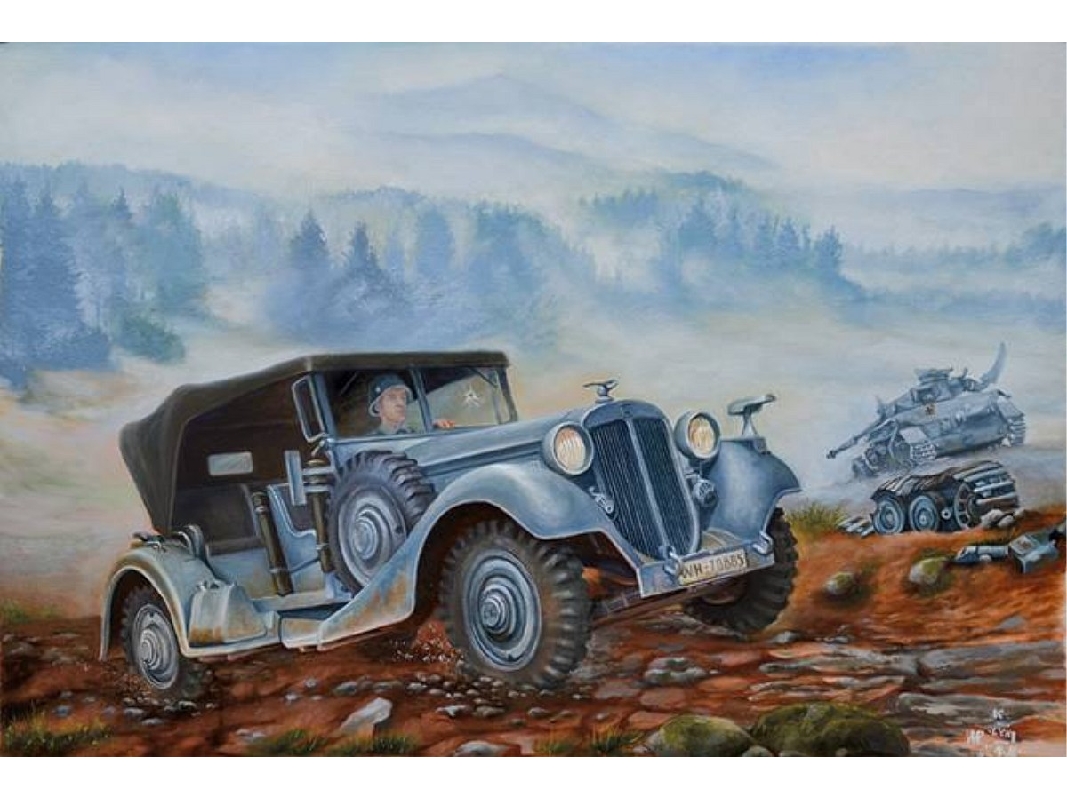

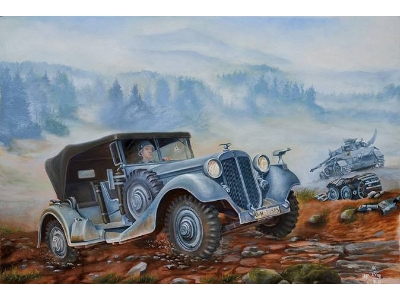
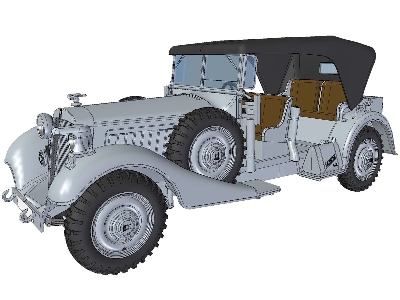
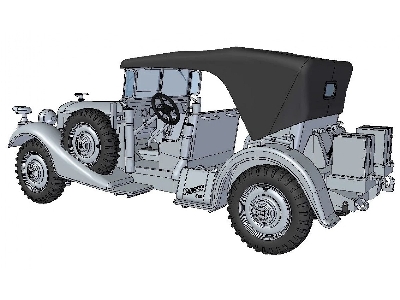
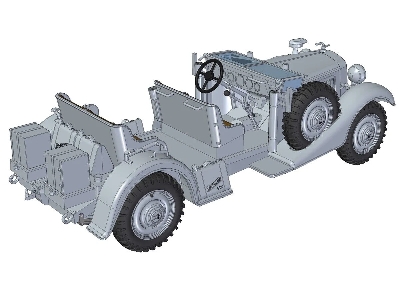
This model represents the German Horch V8 Type 830R, a military vehicle developed for transporting officers and carrying out command and liaison duties. The kit allows the modeller to reproduce the characteristic military version of this large Horch passenger car, featuring an open body, folding canvas top and equipment adapted for field service.
The kit includes plastic parts for the body, chassis, interior and characteristic V8 engine. The model is produced using new tooling and consists of six sprues of parts. Clear parts and decals are also included, together with assembly instructions showing the available finishing options. The kit allows the modeller to choose between two different registration plate variants.
The simplified military bodywork gives the model the distinctive appearance of a vehicle intended for military service rather than civilian use. It can be displayed as a standalone vehicle or incorporated into a larger scene featuring German officers, soldiers and other Wehrmacht vehicles.
The Horch 830R was characterised by a large body that retained much of the appearance of the civilian Horch passenger cars from which it was derived. For military use, however, the design was simplified and strengthened, with the chassis adapted to the more demanding conditions of field service.
The model reproduces a number of characteristic features of the military version, including the simplified interior, open body and equipment associated with military operation. The detailed V8 engine is another important element, reflecting one of the defining features of the original vehicle.
The development of this type of vehicle dates back to the late 1920s and early 1930s, when the German armed forces were looking for suitable vehicles for transporting officers and carrying out command duties. At the time, the Reichswehr was subject to the restrictions imposed by the Treaty of Versailles, making the development of military vehicles based on civilian technology particularly important.
Horch was one of Germany's leading automobile manufacturers and produced large, high-quality passenger cars. These vehicles provided a suitable basis for military adaptations, particularly for roles requiring a relatively comfortable vehicle for officers and command personnel.
In 1932 Horch became part of Auto Union, the newly formed group created by the merger of Audi, DKW, Horch and Wanderer. During the following years, the company became increasingly involved in supplying vehicles to the German armed forces.
The military version of the Horch 830 was not simply a civilian car with military markings. A number of changes were introduced to make the vehicle more suitable for military service. The chassis was strengthened and the running gear was adapted for operation on unpaved roads.
The military bodywork was considerably simplified. Traditional doors were replaced by simpler arrangements, while the open body and folding canvas top made the vehicle more practical for military use and allowed occupants to observe their surroundings more easily.
The vehicle could carry several occupants and was equipped with military fittings, including rifle holders and a rear towing hook. Although its basic design remained related to civilian passenger cars, these modifications gave it a distinctly military character.
Rear-wheel drive was one of the vehicle's limitations when operating in particularly difficult terrain. Although the military version featured a strengthened chassis and improved running gear, it could not offer the same cross-country mobility as vehicles equipped with four-wheel drive. It performed best on established roads and relatively firm terrain.
Military Horch vehicles became increasingly important during the rapid expansion of the German armed forces in the second half of the 1930s. The Horch 830R was used as a command and officer vehicle, providing transportation for personnel who needed to move between headquarters, units and operational positions.
Vehicles of this type were used during the early campaigns of the Second World War. They accompanied German formations during operations in Poland and Western Europe and were subsequently employed on the Eastern Front.
During the early years of the war, the vehicle's combination of relatively high road performance, passenger capacity and military equipment made it useful for command and liaison duties. However, the increasingly difficult conditions of the Eastern Front exposed the limitations of vehicles with rear-wheel drive.
Mud, poor roads and rough terrain placed considerably greater demands on military vehicles than those encountered in normal European road conditions. As newer and more specialised vehicles became available, older Horch models gradually disappeared from first-line service, although examples continued to be used in secondary and support roles.
The Horch 830R occupies an interesting place in the development of German military automobiles. It represents an early approach to adapting passenger cars for military service, combining a civilian-derived chassis with a simplified body and military equipment.
During the interwar period, many countries were looking for lightweight military vehicles that were relatively simple, reliable and capable of transporting personnel and equipment. Germany developed several types of vehicles along these lines, with the Horch being one of the larger and more prestigious examples.
Later German designs, most famously the Volkswagen Kübelwagen, were much simpler and better suited to mass production and military field use. The Horch 830R remained a larger and more substantial vehicle, retaining many characteristics of the civilian automobile from which it originated.
The Horch 830R is an excellent subject for dioramas depicting German forces during the early years of the Second World War. It can be used as an officer's vehicle, a command car or a means of transporting headquarters personnel.
Its large and distinctive silhouette makes it easy to distinguish from smaller military vehicles. The model can be placed beside a field headquarters, near a command building, on a road during a military advance or as part of a larger Wehrmacht vehicle column.
The vehicle also works particularly well with officer and infantry figures, trucks and other German military vehicles. A scene can show the car during a routine stop, while officers are discussing the situation, or during active operations as personnel move between different command positions.
The model can also be finished in a heavily weathered field condition. Vehicles that had originally been based on relatively luxurious civilian automobiles could quickly acquire a much more utilitarian appearance in military service. Mud, dust, worn paint and accumulated dirt can effectively emphasise this transformation.
Note: The kit is supplied unassembled and unpainted. Glue and paints are not included.

No carriers available for this product.
The above shipping costs are for 1 item only.
You will see the final shipping costs when you place your order.

Manufacturer
Responsible person
@COMMENT_COMMENT@
@COMMENT_COMMENT@
@COMMENT_TITLE@
@COMMENT_COMMENT@