

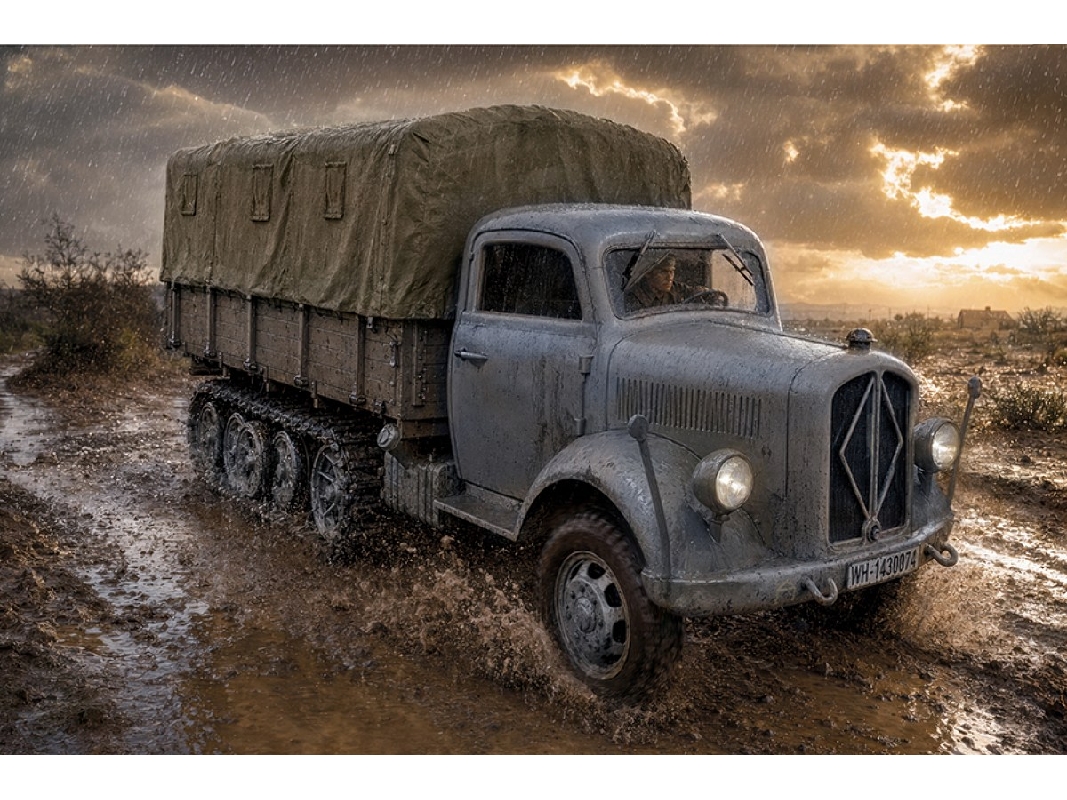

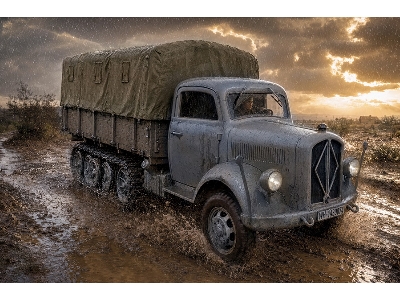
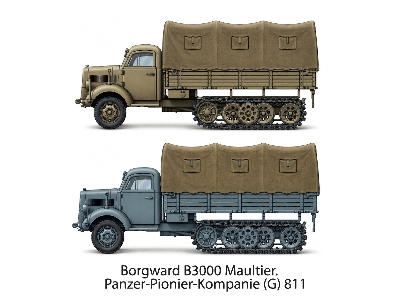
This model represents the German Borgward B3000 half-track truck, known as the Maultier. The vehicle combined the characteristic front section and cab of a conventional truck with a tracked running gear at the rear. This unusual solution was intended to improve mobility on muddy, snowy and soft terrain where conventional wheeled trucks had difficulty maintaining traction.
The kit allows the modeller to reproduce an unusual military transport vehicle whose half-track configuration gives it a distinctive appearance compared with standard German trucks. The model includes the characteristic cab with rounded fenders, long engine bonnet, cargo body and the modified rear chassis with its tracked running gear.
The combination of wheels at the front and tracks at the rear makes this an especially interesting subject for a military vehicle collection. It can be displayed on its own or incorporated into a larger scene depicting German transport and supply units.
The most noticeable feature of the model is the tracked rear running gear replacing the conventional rear axle of the truck. The front wheels retained their steering function, while the driven rear axle was replaced by a tracked assembly. This gave the vehicle considerably greater traction on soft ground while retaining much of the practicality of a conventional truck.
The model reproduces the characteristic proportions of the Borgward B3000. The long engine bonnet and high cab contrast with the relatively compact tracked assembly beneath the rear of the cargo body. It is an interesting example of how an existing truck design was adapted to meet specific military requirements.
The Borgward B3000 belonged to a family of German medium-duty trucks with a payload of approximately three tonnes. Production of the standard versions began in 1938 at the Carl F. W. Borgward factory in Bremen. Although originally developed primarily for civilian use, large numbers of these trucks were taken over by the German armed forces as military requirements increased.
The B3000 was produced in several versions differing in their engines and drive configurations. Rear-wheel-drive versions were intended mainly for road use, while four-wheel-drive variants offered improved mobility away from paved roads.
The truck used a conventional ladder-frame chassis with a front-mounted engine and cab positioned behind it. The characteristic cab with rounded fenders and long bonnet became one of the recognisable features of the B3000 family.
The first years of the Second World War demonstrated that standard wheeled trucks were not always capable of providing sufficient mobility in difficult battlefield conditions. The problem became particularly serious on the Eastern Front, where autumn rain could turn roads into deep mud and winter brought snow and frozen ground.
One solution was to replace the rear axle of an existing truck with a tracked running gear. The Germans developed a family of vehicles known collectively as Maultier, meaning “mule”. The name reflected their role as practical transport vehicles designed to perform hard work under difficult conditions.
The best-known examples were based on trucks produced by Ford and Opel, but the same general principle was also applied to vehicles from other manufacturers. The Borgward B3000 Maultier was one of the less common examples of this approach.
The half-track Borgward retained the front section of the standard B3000, while the rear part of the chassis was extensively modified. The conventional rear axle was replaced by a tracked running gear that provided a much larger contact area with the ground.
The tracks improved traction and reduced the tendency of the vehicle to sink into soft terrain. This was particularly useful when transporting heavy loads, ammunition and supplies close to the front line.
The system also had disadvantages. The tracked running gear was more complicated than a conventional truck axle, created greater rolling resistance and required additional maintenance. The Maultier was therefore a compromise between the simplicity of a truck and the mobility of a fully tracked vehicle.
The Borgward B3000 Maultier was considerably less common than the better-known Opel and Ford Maultier variants. Information concerning its production and operational use is also more limited, making surviving photographs and documentation of the vehicle relatively uncommon.
Its primary purpose remained transportation. The vehicle could carry supplies, ammunition, equipment and personnel while using its improved mobility to negotiate roads and terrain that were difficult or inaccessible to conventional trucks.
Unlike many more specialised German half-tracked vehicles, it was not primarily intended as a combat vehicle. Its importance came from the vital role played by transport vehicles in military logistics. Fuel, ammunition, food and spare parts all had to reach frontline units, and vehicles such as the Maultier helped maintain that flow under difficult conditions.
Half-track trucks represented an interesting stage in the development of German military transport. They allowed existing truck designs to be adapted for difficult terrain without requiring the development of an entirely new tracked vehicle.
This was a practical and relatively rapid solution. Instead of designing a completely new vehicle capable of operating in extreme conditions, an existing truck could be modified by replacing its rear running gear. This provided improved mobility while retaining a large part of the original vehicle's design.
Experience with these vehicles also demonstrated the limitations of the concept. Increased mobility came at the cost of greater mechanical complexity, increased fuel consumption and additional maintenance requirements. The Maultier was therefore a compromise rather than a true replacement for a fully tracked vehicle.
The Borgward B3000 Maultier is an excellent subject for a diorama depicting the logistical side of the German war effort. Its unusual silhouette immediately attracts attention, while the vehicle can be incorporated into a wide variety of scenes.
The model can represent a truck transporting supplies, crossing a muddy road or stopping at a rear-area supply position. It is particularly well suited to scenes depicting the Eastern Front, where difficult road conditions were one of the major challenges faced by German logistics.
The vehicle can be combined with driver and soldier figures, ammunition crates, fuel drums, other trucks and field equipment. Placing it on a heavily muddy road or partially in soft ground can further emphasise the reason for its tracked rear running gear.
Its relatively uncommon subject also makes the model an interesting addition to a collection of German military vehicles. Compared with the much more familiar Opel and Ford Maultier trucks, the Borgward offers the opportunity to depict a considerably rarer variant of German military transport technology.
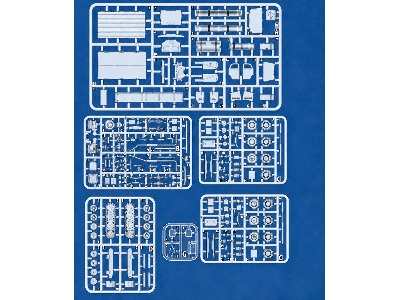
Note: The kit is supplied unassembled and unpainted. Glue and paints are not included.

No carriers available for this product.
The above shipping costs are for 1 item only.
You will see the final shipping costs when you place your order.

Manufacturer
Responsible person
@COMMENT_COMMENT@
@COMMENT_COMMENT@
@COMMENT_TITLE@
@COMMENT_COMMENT@