
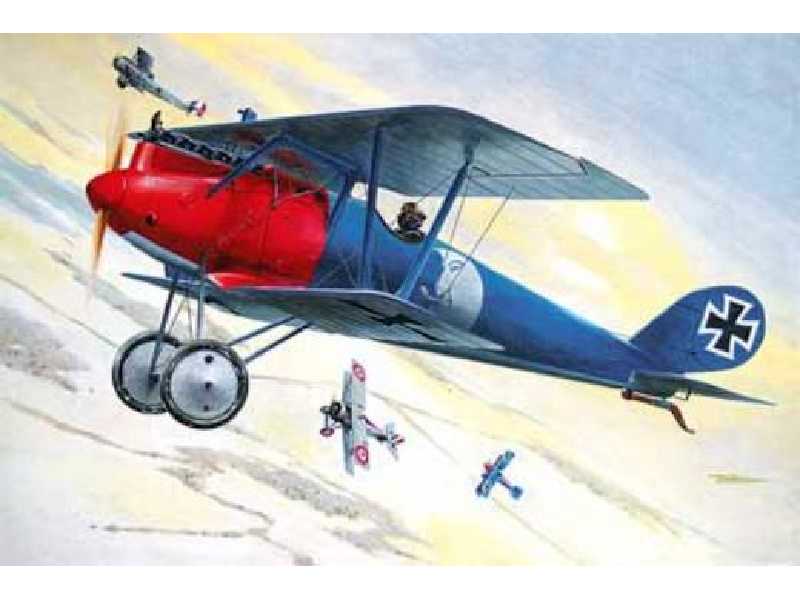

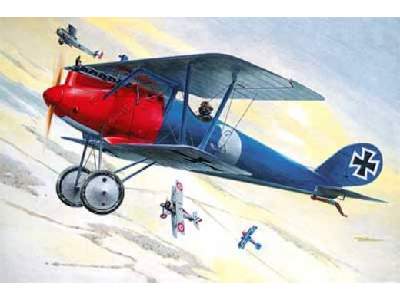
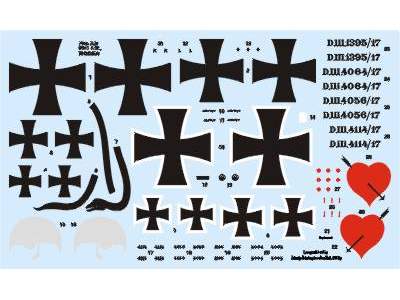
Pfalz DIII, serial unknown, Jasta 10, flown by Ltn. Hans Klein,
1917.
Pfalz DIII, D. 4064/17, Jasta 34 b, flown by Ltn. Rudolf Stark,
1917.
Pfalz DIII, D. 4114/17, Kest 8, winter 1917-1918.
Pfalz DIII, D.4056/17, Jasta 16B, 1917.
Pfalz DIII, serial unknown, Jasta 18, flown by Ltn. W. Kleffel,
winter 1917.
At the end of 1917 the aircraft manufacturer
Pfalz Flugzeugwerke GmbH Speyer am Rhein produced the Roland D.I
and D.II under license. Work on the design of a fighter of their
own began at the start of 1917. The chief engineer was Rudolph Gehringer,
who had a certain amount of experience already, working as an engineer
for Friedrichshafen. He took the construction of the Roland D.II
as a basis and after considerable change a new fighter emerged looking
very different from its predecessor. The Pfalz D.III (the name of
this development) was much the most elegant machine in comparison
with other types - it had a thin streamlined fuselage with an oval
cross section, a trapeziform wing and tailplane, a rounded fin and
rudder, and a small spinner for the air screw. The machine guns
were buried in the front fuselage - a choice more aesthetic than
practical, as it complicated clearing the frequent gun jams.
In the summer of 1917 the first Pfalz D.III appeared at the Front,
and almost at once the initial order was increased from 70 to 300
units. Basic performance figures (maneuverability, climb rate, flying
speed) were acknowledged as excellent but the location of the guns
inside the fuselage prompted criticism. In the course of combat
flying certain problems appeared during intensive maneuvering -
the spars of some lower wings collapsed, although cases were not
numerous and so fatal in comparison with the Albatros machines.
Another problem arose with the ailerons but it was soon solved.
Together with the Albatroses and Fokkers the Pfalz D.III was considered
a first rate fighter, taking part in the great Flying Circuses.
Overall the Pfalz Flugzeugwerke GmbH produced 260 of the Pfalz D.III
type. Following extensive combat experience, and the opinions of
pilots about the airplane, the firm improved the fighter's design,
which in detail was somewhat different from its predecessor, and
soon the first Pfalz D.IIIa appeared at the Front.Nevertheless,
a lot of Pfalz D.III's remained in frontline fighting units. The
last machine was written off in October 1918 just before the end
of the War. It goes without saying that the Pfalz D.III was not
the supreme fighter. Its glory became a little overshadowed by the
successes of the Albatroses and Fokkers, but even so, this type
was acknowledged as a classic fighter of the Great War. And by any
aesthetic criterion it was the most beautiful and elegant airplane
of that period.
Performances
Wingspan
9.40 m
Length
6.95 m
Wing area
22.17 m2
Take off weight
905 kg
Speed(max)/at level
165 km/h / 3000 m
Service ceiling
5100 m
Endurance
about 2½ hr
Engine
one liquid cooled Mercedes D.III, 160 h.p.
Armament:
Machine guns
2xLMG 08/15 Spandau
Product Details
Roden 613
2008-03-08
Data sheet
Scale
1/32
Availability
Sold out
Shipping time
Unknown
Assortment / material
n/a
No carriers available for this product.
The above shipping costs are for 1 item only.
You will see the final shipping costs when you place your order.

Responsible personInternational Business Group Spółka Jawna Piotr Andrzejewski, Lidia Andrzejewska, Adam AndrzejewskiBenedykta Hertza 204-603
WarszawaPolandibgsc@ibg.com.pl+48228159150
@COMMENT_TITLE@
@COMMENT_COMMENT@