
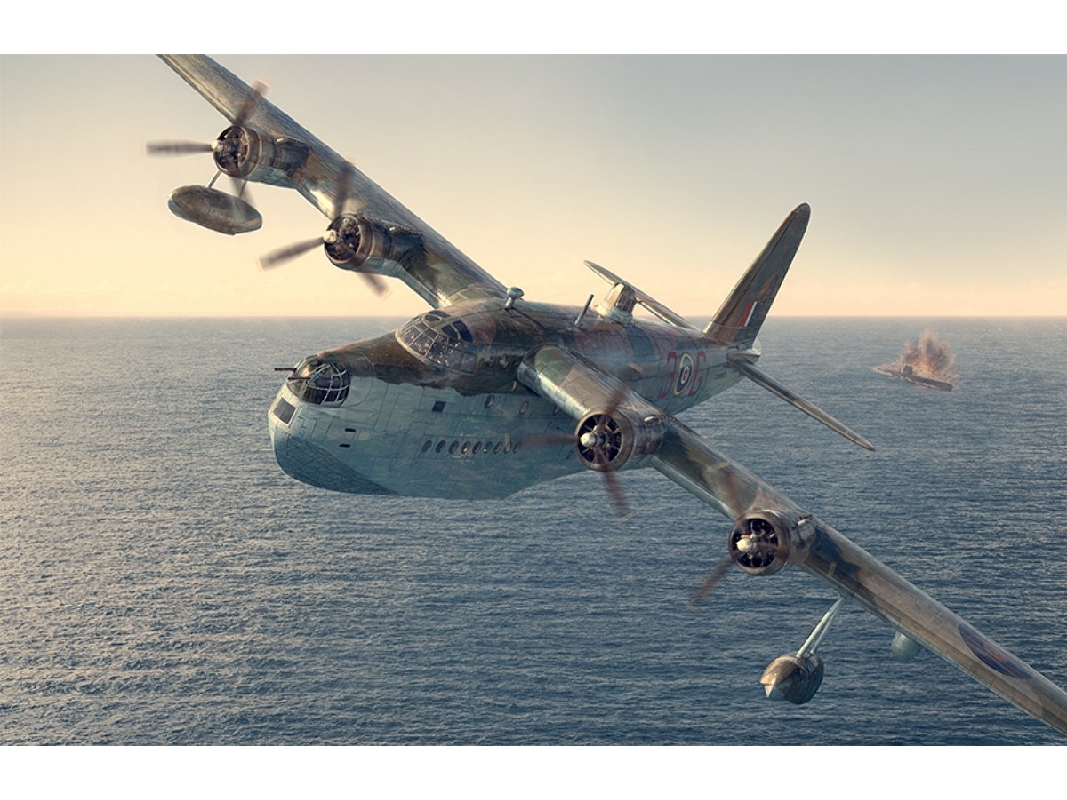

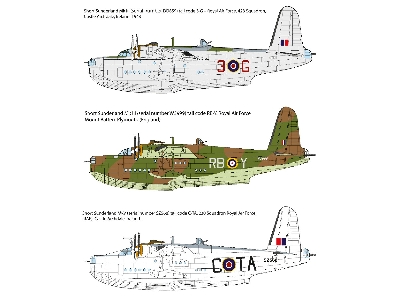
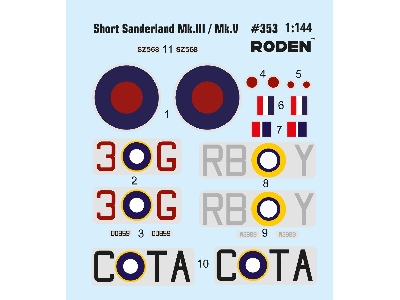
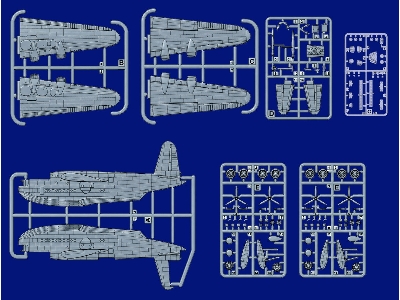
This model represents the Short S.25 Sunderland, one of the most famous British flying boats of the Second World War. The kit allows the modeller to build either the Mk.III or Mk.V version, both of which played an important role in maritime patrol, reconnaissance and anti-submarine operations.
The model reproduces the distinctive hull-shaped fuselage, large parasol wing and four-engine layout of the Sunderland. The characteristic flying-boat configuration makes it a particularly interesting subject compared with conventional land-based aircraft. The extensive glazing, defensive gun positions and large engines are among the most recognisable features of the aircraft.
The kit provides the parts necessary to build either the Mk.III or Mk.V variant. This makes it possible to represent aircraft with different engine configurations and wartime equipment. The Sunderland's large wingspan and distinctive hull give the finished model a strong presence despite its compact display scale.
The kit covers two major versions of the aircraft. The Mk.III became the most numerous production variant and introduced improvements to the hull and equipment. The later Mk.V replaced the original Bristol Pegasus engines with American Pratt & Whitney R-1830 Twin Wasp engines.
These differences are particularly interesting from a modelling perspective because the engine nacelles and propellers are among the most visible external features of the aircraft. The choice of variant therefore has a noticeable effect on the appearance of the finished model.
The Sunderland was developed by Short Brothers as a long-range maritime patrol flying boat for the Royal Air Force. Its design was based partly on the company's earlier civilian flying boats, but the military aircraft was extensively redesigned to meet the requirements of reconnaissance and anti-submarine warfare.
The prototype first flew in 1937, and the Sunderland entered RAF service shortly afterwards. Its large hull allowed it to operate from water while providing sufficient internal space for crew members, fuel, equipment, weapons and supplies needed for long patrols over the sea.
The aircraft was operated primarily by RAF Coastal Command, whose aircraft were responsible for protecting Britain's maritime supply routes and hunting German submarines. The Sunderland became one of the most important long-range flying boats available to the British during the war.
The Sunderland earned a reputation for being exceptionally robust. Its large hull was designed not only to provide buoyancy but also to withstand the demanding conditions encountered during operations at sea. The aircraft could take off and land on open water, allowing it to operate from bases where conventional runways were unavailable.
The hull incorporated a number of features associated with flying boats, including steps and floats that allowed the aircraft to remain stable on the water. When airborne, the Sunderland's large wings and four engines gave it the endurance required for long maritime patrol missions.
Its size also allowed the crew to live and work aboard the aircraft during lengthy patrols. The interior was divided into several compartments, providing space for crew stations, equipment and mission supplies. This made the Sunderland more than simply an aircraft carrying weapons – it functioned as a self-contained maritime patrol platform.
One of the Sunderland's most important missions was the search for German U-boats threatening Allied shipping. Aircraft of RAF Coastal Command patrolled enormous areas of the Atlantic and approached the problem from both the air and the sea.
Once a submarine was detected, the Sunderland could attack using depth charges and other weapons. Its long endurance allowed it to remain over patrol areas for extended periods, increasing the chance of detecting submarines and protecting Allied convoys.
The aircraft also carried defensive armament to protect itself from enemy fighters. The numerous gun positions gave the Sunderland considerable defensive firepower, contributing to its reputation among German airmen as a difficult target to attack.
The Mk.III was the most widely produced version of the Sunderland. It incorporated a redesigned hull intended to improve water-handling characteristics, particularly during take-off and landing in rough conditions.
The improvements made the aircraft better suited to the demanding maritime environment in which it operated. Mk.III aircraft became a familiar sight at RAF Coastal Command bases and were used extensively throughout the Battle of the Atlantic.
The later Mk.V represented a significant change in the aircraft's propulsion system. Instead of the Bristol Pegasus engines used by earlier versions, it received American Pratt & Whitney R-1830 Twin Wasp engines.
The new engines provided improved reliability and performance and helped extend the useful operational life of the Sunderland. The Mk.V remained an important maritime patrol aircraft during the final period of the war and continued to serve after the conflict.
Although closely associated with the Battle of the Atlantic, the Sunderland was not restricted to European waters. Aircraft operated from bases in the United Kingdom, the Mediterranean, West Africa and other locations where long-range maritime patrols were required.
Sunderlands were also used for reconnaissance, convoy protection, search and rescue and transport missions. Their large hull made them particularly useful when personnel or equipment had to be moved between isolated bases and locations without conventional airfields.
The aircraft's ability to land on water was especially valuable in remote areas. A suitable stretch of sheltered water could serve as an operational base, giving the Sunderland considerable flexibility compared with land-based aircraft.
The Sunderland continued in service after 1945, when flying boats were increasingly replaced by land-based aircraft with longer range and improved equipment. Nevertheless, the aircraft remained useful for maritime patrol, transport and other specialist duties for several years.
Its long service life reflected the strength of the original design. The Sunderland combined a large and robust hull with reliable engines, substantial range and the ability to operate from water, making it one of the most successful British flying boats of its generation.
The Sunderland offers many possibilities for a maritime aviation diorama. The most obvious setting is an RAF Coastal Command seaplane base, with the aircraft positioned on a slipway, floating on the water or being prepared for a patrol mission.
The model can be combined with crew figures, ground personnel, small boats, fuel equipment and other accessories associated with a flying-boat station. A water base can also be used to represent the aircraft immediately before take-off or after returning from a long patrol.
A Sunderland can also be displayed as a standalone aircraft. Its unusual flying-boat configuration, enormous wing and four-engine layout make it immediately recognisable and give it a distinctive appearance in any collection of Second World War aircraft.
Note: The kit is supplied unassembled and unpainted. Glue and paints are not included.

No carriers available for this product.
The above shipping costs are for 1 item only.
You will see the final shipping costs when you place your order.

Manufacturer
Responsible person
@COMMENT_COMMENT@
@COMMENT_COMMENT@
@COMMENT_TITLE@
@COMMENT_COMMENT@