


- Reduced price
- New
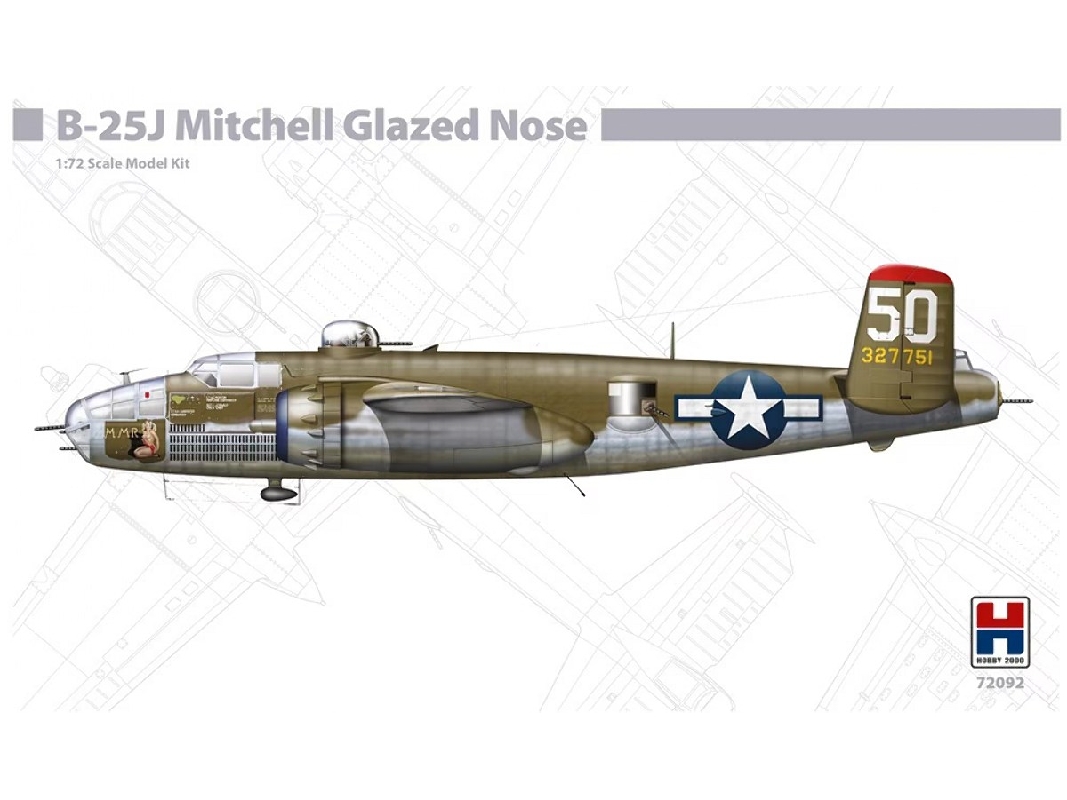

A model of the American North American B-25J Mitchell medium bomber, featuring the glass-nose configuration characteristic of aircraft designed for conventional bombing missions, which included a dedicated bombardier station. This 1:72 scale kit by Hobby 2000 is based on molds from the Japanese manufacturer Hasegawa and includes decals by Cartograf, as well as masks to assist in the precise painting of the glazing.
The glazed forward section of the fuselage captures the bomber’s distinctive silhouette, with the bombardier’s station clearly visible. The included masks simplify the process of painting the numerous window frames, while the decals allow for the creation of one of three historical livery options. The model requires assembly and painting.
Glue and paints must be purchased separately.The included Cartograf decals allow for the construction of the model in one of three variants of the American B-25J Mitchell bomber, as operated in the European Theater of Operations in 1945:
The B-25 Mitchell was an American twin-engine medium bomber developed by North American Aviation. It was named in honor of General William “Billy” Mitchell, a pioneer of American military aviation. The aircraft made its maiden flight in 1940 and saw service on many fronts during World War II, where it was used both to bomb ground targets and to strike enemy transport and infrastructure.
One of the most famous episodes in the history of this design was the raid on Tokyo on April 18, 1942. Sixteen B-25 bombers took off from the aircraft carrier USS Hornet as part of an operation led by Lieutenant Colonel James Doolittle. This was the first American air raid on the Japanese home islands. The operation was primarily of psychological and strategic significance, demonstrating that Japanese territory was not beyond the reach of American aviation.
The B-25J variant was the final and most widely produced version of the Mitchell. Aircraft in this series were built with either a solid nose—housing forward-firing armament—or a glazed nose, which contained the bombardier’s station. The latter configuration followed the traditional bomber profile, in which the bombardier assisted in guiding the aircraft toward its target during a bombing run.
The Mitchell was powered by two Wright R-2600 Cyclone radial engines, each producing approximately 1,700 hp. It reached a maximum speed of around 440 km/h, while its range and payload capacity varied depending on the specific variant, fuel load, and the nature of the mission being performed. It could carry bombs with a total mass of approximately 1,800 kg, and its defensive armament included 12.7 mm caliber machine guns positioned at various stations.

No carriers available for this product.
The above shipping costs are for 1 item only.
You will see the final shipping costs when you place your order.
@COMMENT_COMMENT@
@COMMENT_COMMENT@


@COMMENT_TITLE@
@COMMENT_COMMENT@