


- Reduced price
- New
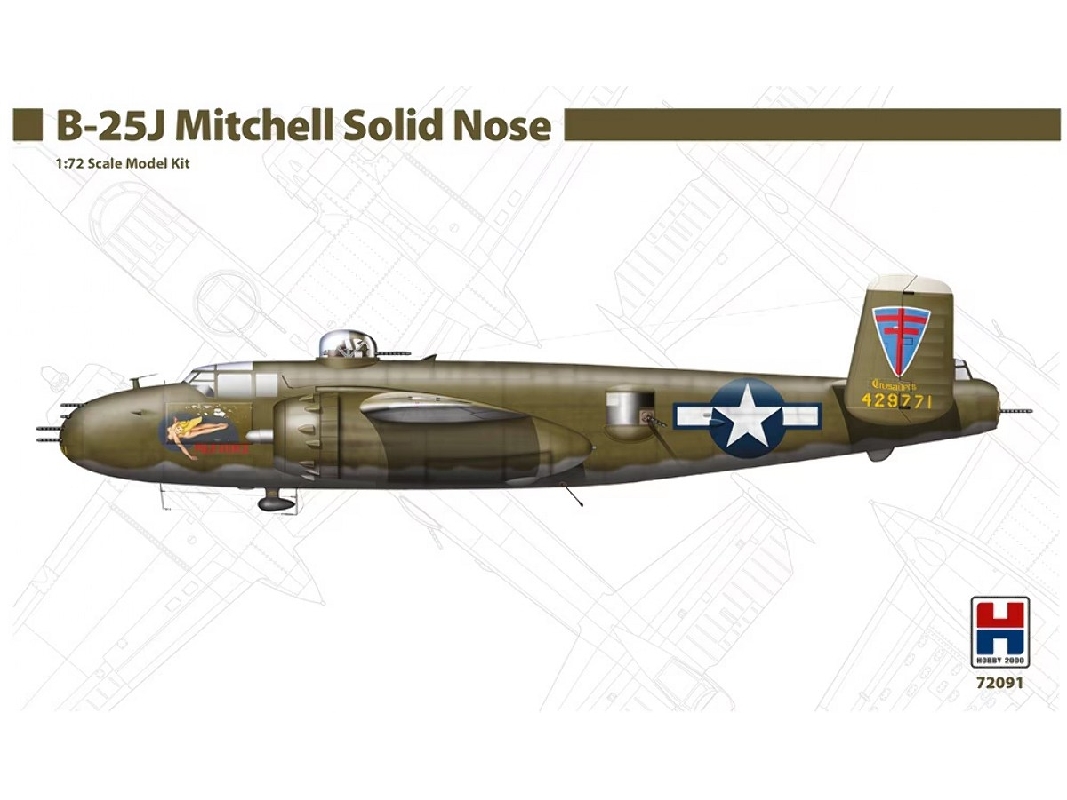

A scale model of the American North American B-25J Mitchell medium bomber, featuring a "solid nose"—a non-glazed nose section housing fixed, forward-firing armament. This 1:72 scale kit by Hobby 2000 is based on molds from the Japanese manufacturer Hasegawa and includes decals by Cartograf, as well as masks to assist in painting the canopy and other glazed areas.
The solid-nose configuration was designed for low-altitude attack missions. In place of the glazed bombardier’s station, the nose was equipped with eight fixed 12.7 mm (.50 caliber) machine guns. Concentrating this firepower in the front of the aircraft allowed for devastating attacks against enemy airfields, transport assets, defensive positions, and naval vessels.
The model allows for the recreation of one of the bombers operated by American units in the Pacific theater during the final stages of World War II.
Glue and paints must be purchased separately, unless otherwise indicated by the kit manufacturer.The kit allows for the construction of one of three B-25J Mitchell aircraft used by United States Army Air Forces (USAAF) units in the Pacific Theater of Operations in 1945:
The B-25 Mitchell was named in honor of General William "Billy" Mitchell, one of the most prominent advocates for the development of military aviation in the United States. The aircraft made its maiden flight in 1940 and entered service at a time when the U.S. Air Force was rapidly expanding its fleet of medium-range bombers. This twin-engine design combined relatively high speed and a robust airframe with the capacity to carry a significant bomb load.
The Mitchell gained fame, among other instances, during the raid on Tokyo on April 18, 1942. Sixteen B-25 bombers took off from the deck of the aircraft carrier USS Hornet as part of an operation led by Lieutenant Colonel James Doolittle. This marked the first American air raid on the Japanese home islands. Although the immediate material damage was limited, the operation held great psychological and propaganda significance.
In the years that followed, the B-25 was deployed across many fronts of World War II.
It played a particularly important role in the Pacific, where bombers attacked Japanese airfields, ports, transport ships, supply columns, and ground troop positions. The operational conditions in this theater of war favored the development of variants designed for low-altitude attacks, featuring heavy, forward-firing gun armament.The B-25J was the final and most widely produced version of the Mitchell. It reintroduced the co-pilot’s station while retaining design features developed in earlier variants. The aircraft was produced both with a glazed nose—intended for conventional bombing—and with a solid nose housing eight machine guns. This latter configuration, known as a "strafer," was especially effective for close-range attacks against ground and surface targets.
The heavily armed nose was not the only source of firepower. Depending on the specific variant, the aircraft also carried machine guns in fuselage-mounted side packs and defensive gun stations. Consequently, in the right configuration, the B-25J could deliver a very intense volume of fire against a target during a single pass. The combination of gun armament and bombs made the Mitchell highly effective in attacking transport assets, airfields, and fortifications—particularly during operations on islands and in coastal regions.

No carriers available for this product.
The above shipping costs are for 1 item only.
You will see the final shipping costs when you place your order.
@COMMENT_COMMENT@
@COMMENT_COMMENT@




@COMMENT_TITLE@
@COMMENT_COMMENT@