
- Reduced price
- New
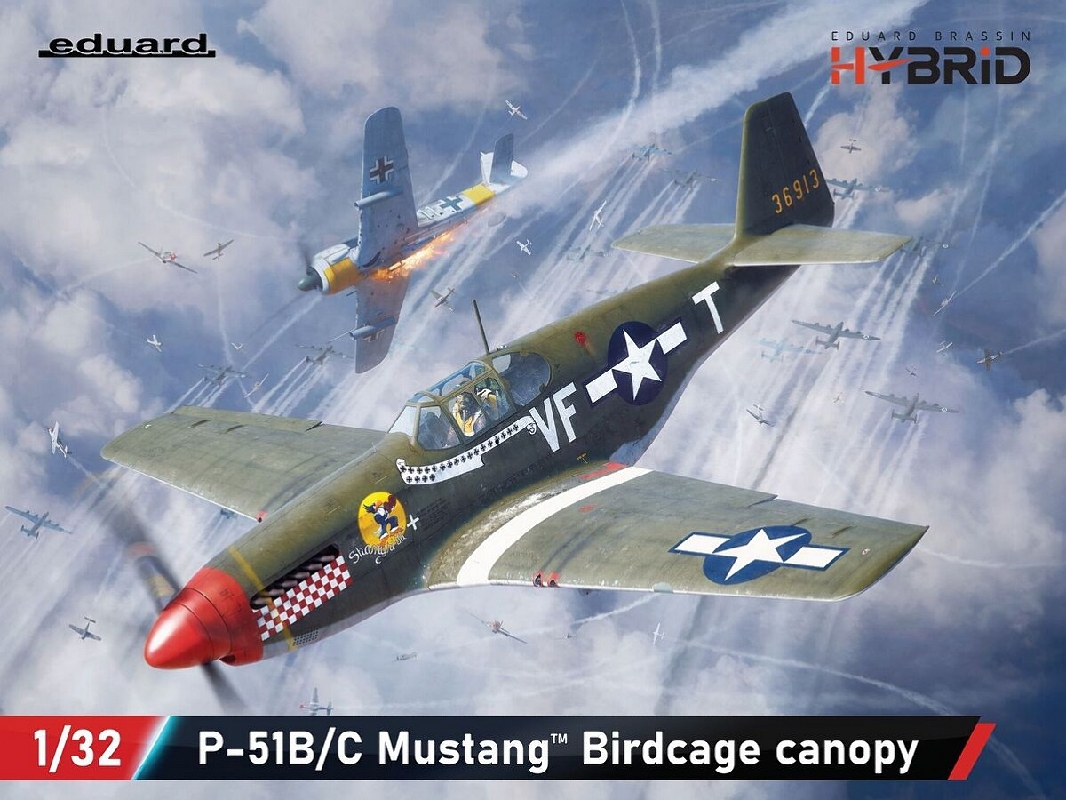

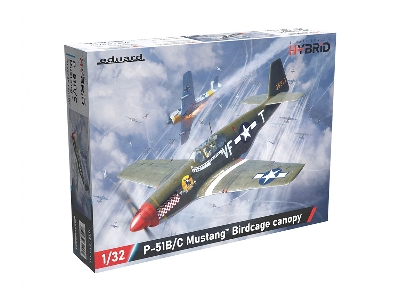
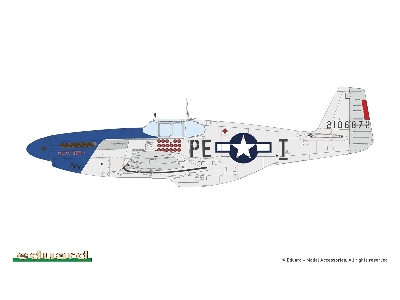
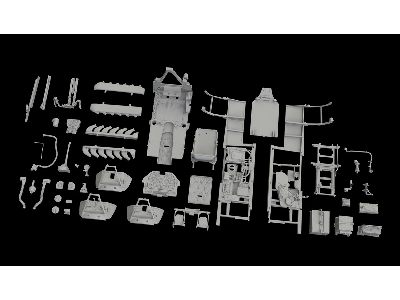
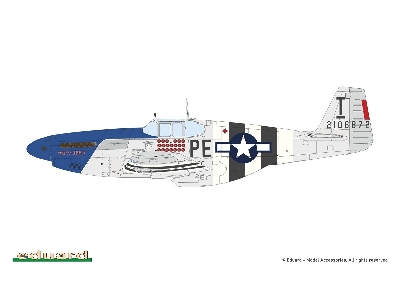
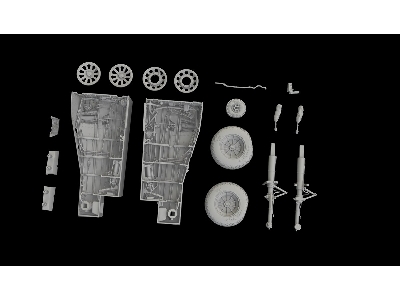
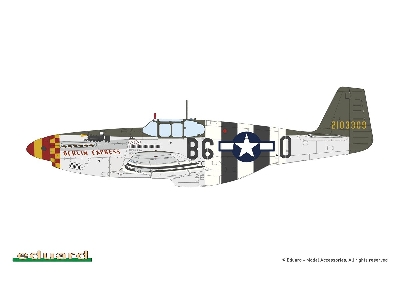
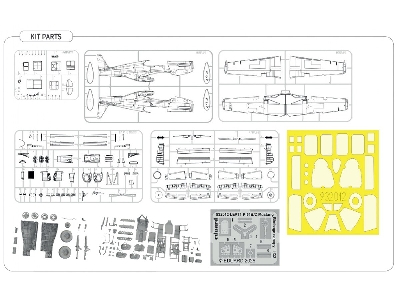
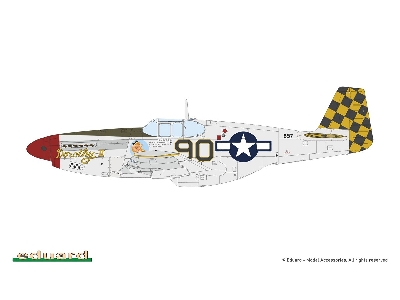
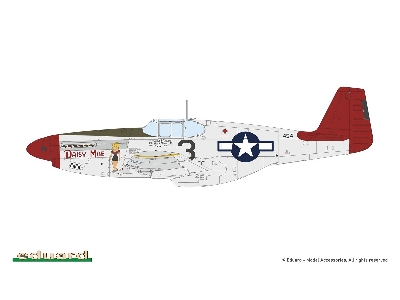
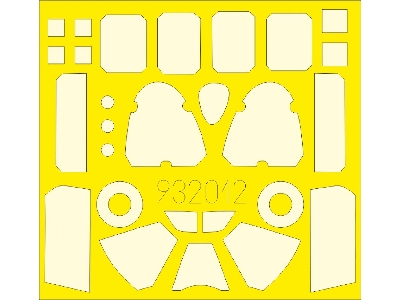
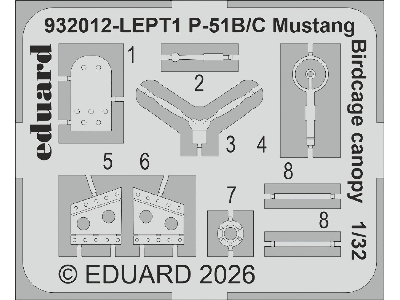
This kit allows you to build a detailed model of the American P-51B/C Mustang fighter with its distinctive Birdcage canopy. It is a Hybrid Edition combining plastic model parts with resin and photo-etched components.
The kit includes extensive resin components for the cockpit, wheel wells, wheels, armament and exhaust system. A pre-cut mask is provided to facilitate painting of the canopy, while the decals allow you to reproduce five specific Mustangs operated by 8th and 15th Air Forces during operations in Europe in 1944.
The model is intended for self-assembly and painting. Glue and paints are not included and must be purchased separately.
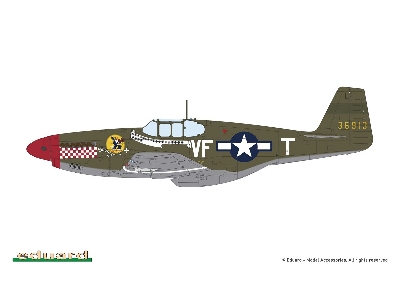
The decals allow you to reproduce five specific P-51B/C Mustangs associated with units of the 8th and 15th Air Forces. Each option represents a particular aircraft with its own history and pilot.
The North American P-51 Mustang was a single-seat, single-engine long-range fighter originally developed to meet a British requirement. The NA-73 prototype was completed in an exceptionally short time – only 117 days passed between the beginning of development and completion of the first aircraft. Its first flight took place on October 25, 1940.
The Mustang was initially powered by an Allison engine, which provided very good performance at low and medium altitudes but was less effective at high altitude. A major breakthrough came with the adoption of the British Rolls-Royce Merlin engine. Its license-built American version, manufactured by Packard as the V-1650, powered the P-51B and P-51C variants.
The two versions were essentially identical in design and differed mainly in their place of manufacture. P-51Bs were built at North American's Inglewood plant in California, while P-51Cs were produced at the company's Dallas plant in Texas. A total of 1,988 P-51Bs and 1,750 P-51Cs were built.
The Merlin engine, equipped with a two-stage, two-speed supercharger, dramatically improved the Mustang's high-altitude performance. During tests, prototypes fitted with this engine reached approximately 441 mph (710 km/h) at an altitude of around 30,000 feet (9,140 m).
The key advantage of the P-51B/C was not a single performance figure, but the combination of high speed, good high-altitude performance, manoeuvrability and very long range. This allowed the Mustang to accompany heavy bombers on long-range missions deep into German territory. The introduction of the P-51B/C into European operations from December 1943 significantly increased the ability of American bomber formations to receive fighter escort.
Early P-51B/C Mustangs were fitted with a heavily framed cockpit canopy, commonly referred to by modelers as the Birdcage. The numerous frame members restricted the pilot's visibility, particularly to the rear. The later introduction of the Malcolm Hood, followed by the distinctive bubble canopy of the P-51D, was partly a response to the need for improved visibility during air combat.
The P-51B/C therefore represents an important stage in the development of the Mustang. These variants retained the characteristic early canopy design, while the Merlin engine gave them an entirely new level of performance.
Dominic Salvatore Gentile was one of the most successful American fighter pilots of the war. He had previously gained combat experience flying Spitfires with the Canadian 133 Squadron before joining the 4th Fighter Group. He began flying Mustangs in early 1944.
On May 8, 1944, during an escort mission over Brunswick, he shot down three German Bf 109s. For this action he was awarded the Distinguished Service Cross. His final wartime record included 17.25 aerial victories and two aircraft destroyed on the ground.
John F. Thornell had previously flown the P-47 Thunderbolt before his unit converted to Mustangs. He named his P-51B “PATTY ANN II”. Between May 8 and June 21, 1944, he scored nine of his 17.25 aerial victories while flying this aircraft.
On May 8, he shot down three Bf 109s during a single escort mission over Brunswick. For this achievement he was awarded the Distinguished Service Cross.
William “Bill” Overstreet became famous for the story of his pursuit of a German Bf 109 during which he was said to have flown through the arches of the Eiffel Tower. The pursuit itself is well known, but Eduard points out that the most spectacular part of the story – the actual flight through the tower – remains unconfirmed. There are also no German records confirming such an event.
Overstreet was nevertheless an experienced and courageous pilot. He later took part in covert operations, including missions connected with the French Resistance. His “Berlin Express” featured distinctive partially olive-drab upper surfaces, while the sides and undersides were left in natural metal finish.
Robert Barkey began combat operations in Africa flying the P-40 and later flew the P-47. After his unit converted to Mustangs, he scored his fifth and final confirmed victory on June 6, 1944. During the war he flew 53 combat missions, achieving five confirmed victories and one probable.
His Mustang carried the number “90”, while his wife's name, “Dorothy”, was painted on the left side of the engine cowling.
The story of “Daisy Mae” is particularly interesting. The P-51C originally served with the 325th Fighter Group, where it was named “Stonewall” and featured a distinctive yellow-and-black checkerboard pattern on the rudder. After the aircraft was transferred to the 332nd Fighter Group, the famous Tuskegee Airmen unit, it received new markings and the name “Daisy Mae”, given to it by Capt. Woodrow Crockett.
The aircraft was destroyed on January 21, 1945, near Opatovice in what was then Czechoslovakia. The pilot, 2nd Lt. Albert L. Young, was killed in the crash, the cause of which remained undetermined.
In addition to the plastic model parts, the kit contains resin components, photo-etched parts, a painting mask and decals. The resin additions include, among other things, the cockpit, wheel wells, wheels, armament and exhaust system.
No. The kit is designed to build the earlier P-51B/C variant with the Birdcage canopy.
The decals allow you to build five specific aircraft associated with units of the 8th and 15th Air Forces. They represent aircraft flown by Dominic S. Gentile, John F. Thornell, William B. Overstreet, Robert M. Barkey and Woodrow Crockett.
No. The model is intended for self-assembly and painting, so glue and paints must be purchased separately.

No carriers available for this product.
The above shipping costs are for 1 item only.
You will see the final shipping costs when you place your order.
@COMMENT_COMMENT@
@COMMENT_COMMENT@





@COMMENT_TITLE@
@COMMENT_COMMENT@